
Archive for HAGARTY TALES
Note: From time to time I am asked to pen a piece far afield from my typical areas of interest. The following is a discussion of a little known program seeking wider acceptance.
Employee leave sharing: sound idea waiting to blossom
Within the Federal Government, employees regularly donate vacation or sick leave to fellow workers who are experiencing medical emergencies and are in need of time off. The program embodies the Golden Rule.
And yet, for nearly three decades this unique employee benefit has been implemented largely by state and local governments, educational and health institutions and non-profits.
The private sector has seemingly ignored its adoption; one designed to build employee morale and commitment.
In an era when workers are asking for more balance between work and lifestyle the question presents: Why not the expansion of a good thing?
It’s a serious question for human resource professionals. Today, a large segment of the work force is known as millennials, born between 1980 and 1992. This cohort is focused on career income and benefits.
Nearly 60 percent of millennials have already switch careers at least once and most say they are unlikely to stay with their current employer. As a result, companies increasingly offer fringe benefits crafted to make its work environment more attractive to talented employees.
Perhaps Silicon Valley’s hi-tech firms personify the degree to which businesses lavish such perks on it employees.
Benefits like bike repair shops, comfy chairs called Nap Pods, exercise and yoga classes, barber shops, car rentals to run errands, gaming arcades, concierge services and even helicopter rides are just a few of the goodies bestowed on employees in the land of hi-tech.
So it begs the question of why more firms are not offering a benefit as simple and straightforward as leave sharing.
In the beginning
The concept of leave sharing became Federal law when President Ronald Reagan signed the Federal Employees Leave Sharing Act of 1988, directing agencies to establish the program.
 In 1989, the program was expanded to include the creation of a Sick Leave Bank whereby Federal employees could donate leave to an agency bank and request leave from it after exhausting personal accrued leave.
The concept caught traction within state governments and today 19 states offer some form of a “sick leave pool”.
In 1993, the original law was reauthorized and the Government Accountability Office testified before Congress that the program had operated successfully since its inception and employees favored its continuance.
Moreover, GAO found the administrative costs were low and that an employee attitude survey found 20 percent of employees had donated leave and one percent had received donations. Not a profound impact but certainly beneficial to those employees in need.
In response to a recent inquiry to the Office of Personnel Management, the agency stated: “According to feedback from Federal agencies, the programs have been successful and they are often used by employees who have short-term personal or family medical emergencies.”
OPM does not maintain a total count of employees who use the programs. Those numbers are tracked by individual agency. Federal employment totals 1.8 million, excluding the United States Postal Service which is not an executive agency; its employment count is 486,822.
Notwithstanding the sanguine view of the Federal program, a recent informal survey of private sector businesses in the Piedmont region confirms that leave sharing is embedded in few human resources policies. Where it has been offered, its success is evident.
Under the Fair Labor Standards Act public employers are able to provide compensatory time off instead of monetary overtime compensation, providing there is an agreement between the employer and employee.
It appears private companies have elected to adopt a similar “in-house” solution to leave sharing.
Fauquier Health
 Fauquier Health is one of the largest firms in the Piedmont region, employing approximately 1,200 people.
Its services run wide and deep and include a 97 bed hospital, long-term care and rehabilitation nursing facilities, a 72 person assisted living operation, home health and wellness centers and a physicians practice.
Its Human Resources Department is headed up by Vice President Katy Reeves. The organization has a “Paid Time Off Donation” program. There are no separate vacation or sick leave plans.
Rather, the earned leave program “combines a vacation bank, a sick leave bank and a holiday bank. You put all of those days in one bank. Then an employee picks and chooses how they use their combined leave,” said Reeves.
The leave policy is structured so it doesn’t penalize employees who never use sick leave from being able to use it as paid time off for vacation. Moreover, additional flexibility permits each worker to donate leave to a fellow employee under certain conditions.
“For example, Betty can’t draw on John’s leave bank unless John wants to donate his hours to her. And it has to be for some type of hardship; a cancer treatment, car accident, a child or spouse undergoing some type of medical treatment,” explains Reeves.
A receiving employee cannot use donated leave to go on vacation and Human Resources must approve all leave donation requests.
“It has been extremely successful. It’s limited to medical emergencies and it’s used as frequently as needed. We always seem to have somebody in need of leave. I am continuously amazed at our employees and the number of people who step up to the plate and donate leave,” Reeves said.
The program in execution reflects the best of its intent. But it comes with a price tag.
“It’s absolutory a cost to Fauquier Health. If you look at why other companies don’t offer this kind of program, I would say the biggest barriers are financial,” Reeves said.
As an example, she elaborates that one cost factor involves hours donated by a staff employee being used by a department director. “The leave has been donated at a lower rate of pay but paid out at a higher rate.
“You budget for what you are going to spend. So suddenly, if you planned costs of $100 for a certain employee but they make a donation to another employee earning more money, the company liability might be $200. That’s a potential risk for companies with a paid time off donation program,” Reeves said.
One work around to the issue is for a firm to take the value of the donated hours and convert them to dollars. “But administratively that’s a huge undertaking.”
Similar financial issues present themselves in administering the program. For example, determining who is eligible to give and receive hours and tracking the leave exchanges, either manually or in the payroll system. “For us it’s a cost of doing business.”
“Our donation program is another example of the fact we are in the health care business; caring and compassion and taking care of people. If we don’t take care of our employees, they won’t be able to provide for the care of our patients. It’s the complete cycle of making sure we are treating our folks right,” Reeves said.
Former CEO
Gary Newell is the former owner and CEO of Buccaneer Computer Systems and Services in Vint Hill. He embodies the entrepreneurial spirit that drives successful companies.
In March 2000, he created his small firm and 10 years later had grown it to 700 employees scattered across six states. In September 2010, he sold the company for $65 million. The man knows how to wield a sharp pencil.
Newell explains that he had an employee suggestion program at Buccaneer. One worthy submission was to create a shared leave program. He looked at two concepts in evaluating the proposal. One was for people to donate to a leave pool; the second was for a direct employee-to-employee donation.
“Either way we looked at it, it was an accounting nightmare,” said Newell. “Especially when you are doing government contracting business. You can be audited anytime by the government.
“If I had an employee making $200,000 a year who was very sick and another employee making $50,000 a year who wanted to donate leave to the person, the donated leave is a different dollar value.
“But you can’t take a portion equal to giver’s salary and donate to the higher paid employee. You would be giving away salary information and that is very confidential.
“The employee could donate four hours of leave but the sick guy could only use one of those hours. It gets very, very messy accounting-wise.
“If you do a direct one-on-one donation, it turns into a popularity contest. When I only had three or four employees, it wouldn’t have been a problem. But when you get to 700 employees you can’t do individual things for individual people. It leaks out and everybody expects it can be done for them,” Newell explains.
Newell goes on to underscore another issue he sees as problematic. There are a certain percentage of employees who as soon as they earn any vacation or sick leave use it. More mature employees build up their leave in case emergencies arise.
“So what you are doing with a shared leave program is benefiting those people who use their leave the moment they earn it. They know there is a pool of leave waiting for them. Those types of people don’t mind spending other peoples’ leave.
“And by the way, who makes the decision who gets to tap into the leave? Where do you draw the line on how sick you have to be? And what if the pool is empty?
“It took about a 30 minute meeting with my human resources and finance managers to decide the juice just ain’t worth the squeeze,” said Newell.
Excelsior Pay Group, LLC
Tianna Wells is director of client services at Excelsior Pay Group in Manassas. The firm “helps eliminate administrative burdens of workforce management, accounting and training.”
“I do see leave sharing being able to help employees in the near future. The program is gaining in the private sector,” Wells said.
She goes on to describe a personal experience with the concept. Her husband was injured in a motorcycle accident and “I had exhausted all my leave. So the option was worked out for me because a co-worker extended her leave to me during my time of need.”
At the time, the company she worked for did not have a formal leave sharing policy in place but afterwards adopted one based largely on her experience. The firm was a subcontractor servicing Federal contracts.
“I’m not sure why it isn’t being offered as a fringe benefit in the private sector. I assume companies don’t want to put pressure on their employees to share the leave they’ve worked hard for.”
Wells could not cite any examples of companies she knew who currently offered the benefit but still sees the likelihood it will expand. “In this day and age a lot of employers are trying to gain significant employees and may feel a need to do as much as they can to entice people to work for them.”
However, she thought the option was one that almost always would be executed on an exception basis.
“While I do see the program growing, I don’t see it being part of a company’s policy but rather being exercised at the discretion of management,” Wells said.
Pangea Global, LLC
Pangea Global is a human resources consultant firm located in Haymarket. Its principal is Jeff Brown. Brown echoes the experience of other private sector executives; to wit, leave sharing is a benefit enlightened employers handle on their own without a formal policy being established.
And it is normally exercised as an exception instead of a blanket policy. He believes the Federal policy has been established to create a level playing field where individual managers don’t have the autonomy to offer it at their own discretion.
“But in businesses they grant mangers the flexibility to provide for additional sick leave up to a certain point. As a practical matter, six months is the outside range. Beyond that long term disability comes into play.
“I’ve never heard of a leave sharing policy within the private sector; never encountered anything like that.
“In fact, the only time I’ve heard of it anywhere was in the Federal government. A friend of mind who passed away from cancer worked at the State Department. She had the benefit. It’s a completely different way to approach the problem than in the private sector,” Brown said.
Fauquier County Government
There are approximately 600 employees in the Fauquier County government; two forms are leave sharing are available for their use.
First, there is a leave bank. An employee can gain access to the bank by simply donating 7.5 hours of leave into it. This “deposit” then permits the employee to withdraw up to 60 days of leave a year for medical emergencies or work related injuries. To be eligible they must have exhausted their own personal leave.
Employees cannot normally donate leave to one another unless of serious medical necessity. But if they have exhausted leave from the bank, they can make a special request for the county to seek donations from all employees on their behalf. The county administrator must approve the exception requests.
The flexibility and generosity of the program is impressive.
Deputy County Administrator, Katie Heritage, said,” The program has been offered for the 20 years I’ve been here and I’m sure longer than that.
“It’s a great program because you give one day of leave and have this wonderful access to a pool of leave. Nobody wants to think they will have to use it. But you never know.
“The exception program shows that county employees are, in my experience, extremely generous with their donations; even if it’s not to somebody in the same department. I think it shows a great thing about the county government,” Heritage said.
One employee who echoes Heritage’s views is Miles Friedman, director, Fauquier County Department of Economic Development. He holds the position after serving for 27 years as head of a nonprofit association in Washington, D.C. His opinion as to why leave sharing is limited in scope is insightful.
“I think one reason why you see it more in governments and nonprofits is they can’t pay the way the private sector does. Nonprofits try very hard to make up in employee benefits what they can’t do in salaries,” Friedman said.
When Friedman led his nonprofit he was always looking for ways to do “nice little things” for his employees such as covering childcare costs, helping out with emergencies or giving them access to counseling if they had issues.
Leave sharing was one of the perks included in the benefits package. “We tried to make it like a family.
“It’s a different culture in the private sector. You are paid handsomely and receive nice benefits like vacations, nice offices, travel expenses and so forth,” Friedman underscores.
He doesn’t believe private companies are “being crass” but just feels their employees are already being taken care of. “It’s how they do it.”
Asked if based on his extensive experience he could recall any private companies offering leaving sharing, he responded with a simple, “I can’t.”
Summing up
Even considering the differences between government and government-like organizations and private businesses, it seems facile to simply dismiss leave sharing as something that won’t work in the private sector.
At its core, leave sharing is charity in action; a character trait that, perhaps more than ever, should be fostered within government and commercial firms alike. But the realities of a free enterprise economy dictate business decisions are rarely driven by altruistic motives.
Yet, the search by young workers for employers who balance work and lifestyle issues presents the private sector with an opportunity to simultaneously serve their employees and the commonweal through leave sharing.
It’s a modest proposal seeking wider adoption. A continuing dialogue seems in the best interests of all.
Published in the Summer 2015 edition of the Business Journal.
Casanova artist driven by passion not marketplace
Dana Lee Thompson picked up a paint brush at the age of 12. She hasn’t put it down since. Not that the urge to create was always smooth.
“My mother gave me watercolor classes with I was 12. But I got kicked out of class. I was always playing with the brushes and slinging water on my friends,” Thompson said laughing.
Hmmm…one wonders how many of her former classmates are professional artists today? Maybe a little slinging goes a long way.
Her creative urged prevailed before and after her unfortunate first art classes. She drew and painted as a child driven simply by her imagination. “I use to copy cartoons and draw the same pointer dog over and over.”
 Her love of animals never left her and today she is a highly respected artist and a signature member of The Society of Animal Artists, a renowned organization comprised of members who produce the best animal art in the world.
“”I’m very, very proud of my acceptance into the Society. When I first started painting, I would look at their catalogs and just dream that maybe I too could be in those catalogs,” Thompson recalls.
It is well-founded pride because Thompson is largely self-taught. When viewing her art, it’s hard to comprehend she was not classically trained.
Her talent and perseverance has scored numerous awards over the years and her work is highly sought after.
Dual career
As a young woman Thompson attended college and pursued a career as a dental technologist. Art was her passion but life demanded that bills be paid. A steady income trumps fervor.
Nonetheless, her choice of careers underscored her creative urge. Dental technologists work from prescriptions to construct custom-made restorative and dental appliances. One doesn’t typically associate prosthesis and dentures with art but artistic talent lies at heart of both professions.
While her career was advancing she continued to paint. She also fell in love with all things fox hunting and rode with the Casanova Hunt for several years. Hounds and horses began to dominate her art.
After two decades of dental work, Thompson decided to pursue a full-time art career. “I worked in Reston and couldn’t take the commute anymore. I decided to quit and go full-time,” Thompson said.
But after five years, the economy began to sputter, bills began to mount and she returned to the dental lab. Today she paints after work and on the weekends.
It’s frustrating for her because the required creativity of her dental work can sap the creative energy necessary for her art. Today, such conflict has diminished given her experience, but she still renders only two to four paintings a month.
She also is moving away from predominately horse and hound art to painting feathered friends. “I love birds. They challenge me. I’d Like to get more confident in painting birds so I’ve been painting a lot them lately.”
She has travelled to Africa three times with one of her sisters because the bird life there is so abundant. She will return again next year. She also visits another sister in Florida to capture its unique bird life including egrets, herons, pelicans and more.
Not surprisingly, she is also a professional photographer and creates digitally exotic birds that will often blossom in oil upon return to her studio.
The future
As her career as dental technologist winds down, Thompson is looking forward to painting full-time in a few years.
She will continue to pursue art based on what attracts her not necessarily what the market requests. “Marketing is tough in the art world. Some are better at it than others. I tend to paint what interests me and if it happens to sell, that’s a plus,” Thompson said.
At any give time Thompson has seven or eight paintings for sale. When asked if she ever keeps certain pieces for herself, she responds with sound industry advice, “They say it’s not a good idea to keep your work. If you can sell it, it helps build an artist’s reputation.”
The cost of her art ranges from $400 for miniatures to $3,000 for full-size paintings.
The artist’s palette
Technique drives performance
Dana Lee Thompson works strictly in oils. She does not paint thickly but employs a technique called alla prima, or wet-on-wet, using multiple thin layers.
The method is predominately used with oil in which layers of wet paint are applied to previous wet paint. It requires working fast because second layers must be applied before the first ones dry. It is also referred to as direct painting.
Her art does not find a home on canvas but rather an artist’s wooden board made of birch, oak, chestnut or cherry woods. The surface of the wood is much harder than canvas and enables her to rendered scenes more graphically.
“I don’t get the bounce I would get on canvas with its little holes,” Thompson said. “I am more confident painting on board than on canvas.”
She first sketches out her subject on the wood and then quickly begins painting. Many artists paint in layers over time. Thompson paints everything at once.
A large painting typically requires two eight-hour days to complete. “Some artists just keep picking at their work and it ends up getting overworked. I work on it for a couple of days and then ask advice from other artist friends,” Thompson said.
Another feedback technique is to hold the finished painting in front of a mirror and see what flaws jump out. “If something is really bothersome you can see it in reverse. I use those techniques as well but most of the time when I’m finished painting, it’s done.”
Since much of her art is rendered from photographs she has taken of the subject, comparing the final art to the original photo will also highlight what might be bothering the artist.
Her advice for struggling artists? “If you are interested in painting, the biggest thing to do is paint a lot. I don’t think you can’t get a lot accomplished if you just paint here and there,” said Thompson
Ahh, so practice does make perfect.
Thompson’s work is available for sale at the Berkley Gallery in Warrenton and her oeuvre is displayed on her website http://www.danaleethompson.com/.
Published in the Summer 2015 edition of inFauquier magazine.
Fauquier County home to growing coyote population
They are everywhere but nowhere. They range the entire state of Virginia surviving and thriving on all matter of food from grass to house pets; if it’s edible its fair game. And yet to spot one is a rare privilege bestowed upon the precious few.
Consider: There are 8.2 million Virginians and at least 50,000 coyotes in the Commonwealth. But try to find someone who has seen one. Wile E. Coyote has a well-earned reputation for elusiveness.
 It is believed the first coyotes in Virginia were Midwestern pups brought in by man during the 1950s, raised and then released. But by the late 1970s, a decades-long natural migration from the southern states was in full bloom. Soon after, the animal dropped down from the northeast joining his southern brothers and creating a pincer movement into the Old Dominion.
Today, there is a minimum of 2,000 coyotes in Fauquier County. They are here to stay. The animal has a legendary track record for being impossible to eradicate. One could even say it’s a lost cause; something old-line Virginians have historical knowledge of.
“We do not recommend counties establish bounties. They don’t work,” said Mike Fies, wildlife research biologist with the Virginia Department of Game and Inland Fisheries. “There’s a 150-old-year record of total failure. You can’t kill enough coyotes with a bounty system to make a difference in the population.”
Nonetheless, 17 out of 95 counties in Virginia offer bounties ranging from $25 to $75 a pelt. Fauquier County is not included. A typical male weighs 45 pounds and a female about 10 pounds less.
With or without bounties, the number of coyotes in Virginia continues to grow; slower west of the Blue Ridge where they are well-established and faster in the Piedmont and counties surrounding the nation’s capital.
One enduring rumor is the Shenandoah National Park brought coyotes in to maintain its deer herds. “I’ve heard that rumor for 30 years,” said Fies. “It’s hogwash.” Once they breeched the Mississippi River their movement east was slow but inexorable.
But man rarely interacts with them, and livestock and pet depredation are not a major problem—yet—so is their presence cause for real concern?
The Trapper
Finding someone who has interacted with a coyote is like finding trout in an overfished stream. Good luck. But one line of work provides amble opportunity to come face-to-face with all manner of wildlife: The trapper.
Trapping conjures up visions of mid-1800s mountain men opening up the west. Yet the profession still exists in the 21st century. Often, today’s trapper is employed to eliminate a “problem child” of the forest and fields.
Burt Herbert, owner of Animal Removal for Keeps based in Manassas, traps throughout Northern Virginia. He has trapped coyotes in Fauquier County but the majority of calls for help come from Lorton and Great Falls. Great Falls? “Oh yes, we even have them around Sports Authority in Manassas,” said Herbert. Who knew?
“The eastern coyote is much more wily, cunning and bigger than the western coyote,” said Herbert. This is likely due to its hybridization with wolves in Canada and the northern states before descending down the east coast.
“Most of my phone calls are due to coyote sightings around houses where they are killing people’s pets. If they kill the dog, they will usually leave the dog. But if they kill the cats, they usually take them away,” said Herbert.
As a professional trapper, Herbert has 30 years experience and has an endless number of tales to share; some quite extraordinary. “I’ve seen a coyote scale a six-foot-high privacy fence with a cat in its mouth. I didn’t believe it could have gotten up it but it sure did,” he recalls.
To provide an even clearer picture of the scope of the Fauquier County population Herbert said, “There have been packs of over 20 in the county. I know somebody who shot 23 of them in one evening coming down to kill his sheep.”
He elaborates that the animal’s diet ranges from grass, mice, rabbits, fawns and cats up to sheep and calves. They are opportunistic hunters.
Notwithstanding his first-hand experience, his coyote trapping is limited to about a dozen kills last year; certainly not reflecting an epidemic of depredation.
Coyotes are legally defined as a nuisance species and can be hunted year round. But given its limited intrusion into the lives of humans a case might be made for a live and let live attitude.
Whatever one’s take on coyotes, it is without a doubt one of the most intelligent and fascinating creatures in the wild kingdom.
Living with coyotes
Follow the rules and pets will remain safe
No animal has greater respect for you than Mr. Wily Coyote. Its respect and fear of Homo sapiens has been purchased at great cost.
The animal has been relentlessly hunted for over 200 years and paid the price with much loss of life.
Of course, it’s learned a lot along the way too.
So while it has nothing to do with you personally—hey, a guy has to eat—pets are almost irresistible dining if given the opportunity to strike. Hunger trumps respect.
Here are the keys to keeping the clever ones at bay:
*Remove all unnatural food sources from around your home. Pet food left on the porch or overflowing garbage cans are fast food restaurants to the dining out coyote. If they find these treasures with any regularity at the same location, a real problem emerges; they can become emboldened. That’s not good.
*Do not tolerate coyotes around your residence. It’s seemingly a feather in your cap for a coyote to find your homestead inviting (is it the landscaping or the color of my home?) but habituation to man is the leading cause of attacks on four-legged family members. More seriously, it may even evolve into aggressive behavior toward you.
*When walking small dogs or playing with children in known coyote habits, keep pets on a leash and children close at hand. Attacks on humans are extremely rare but take no chances.
*If you spot one in the yard, make sure it knows it’s unwelcome. Yell or throw non-edible objects in its direction. It can’t read “No Trespassing” signs but humans who are aggressive will send them packing.
Finally, if you do see one at a safe distance consider taking a video. You’ll be assured of multiple likes on Facebook or even a viral run on YouTube. Yep, that’s how rare filmed encounters are.
Published in the Summer 2015 edition of inFauquier magazine.
When hunger strikes Pepper’s Grill is there to serve; breakfast, lunch or dinner. But dinner time is prime appetite country and the restaurant has a new dining room chef with a lengthy resume written in the kitchen.
 In December, Mike Tylar figuratively placed his chef’s toque on and began redesigning the dinner menu at the respected local eatery. Since then the number of diners has increased each month.
“Business has increased 15 to 20 percent in the last few months,” Tylar said. “My goal is to get it up to at least 50 percent” over last year.
That’s the kind of goal setting the dining-out public loves. The reason any business succeeds is paying customers. And in the restaurant industry tasty food is the catalyst for ringing cash registers.
A profitable menu is a diner’s delight, producing the sought after win-win situation.
The reason for the winning formula lies in the lengthy resume Tylar brings to the kitchen. He has been cooking throughout the Piedmont region for years, including 25 years at The Bavarian Chef in Madison; a restaurant that enjoys a four-star Yelp rating.
“I have been cooking all my life starting at age 15,” said Tylar, 51. Most of his career was centered in Orange and Madison counties but when the opportunity to work at Pepper’s came up he pulled his German apron off and headed north to Culpeper.
“I had been cooking German food for a long time and wanted to try something different,” said Tylar. Germanic food tends to be heavy with large portions. “It’s rich but good.”
Pepper’s offered the opportunity to create a much wider array of dinner menus. Tylar has not disappointed himself or his customers. New menu items have included red pepper soup, cordon bleu, and a Chesapeake seafood dish of shrimp, scallops and crab wrapped in a puff pastry.
One dessert favorite is his fresh cheese cakes. “They really seem to like the cheese cake,” Tylar said smiling.
Other attractive options luring the local dinner crowd are daily specials; shrimp and scallop Italiano, and chicken alfredo are among the new entrees.
In addition to his chefs’ duties, Tylar will be assuming control over staffing and eventually food and supply ordering.
Pepper’s Grill has a large dining room capable of sitting over 200 diners. It hosts weddings, receptions, business meetings and a host of other special events. It also has a vibrant catering service for business and private events; either for pickup or delivery.
On major holidays special menus are designed to serve both local and out-of-town guests. The upcoming Mothers’ Day celebration is a “prime” example.
 “Our specials that day will include prime rib with fried oysters, swordfish with dill cream sauce, roast pork with a chive cream sauce and chicken with wild mushrooms.” Mom is smiling already.
Tylar underscores he’s had great staff support since coming on board. Everyone has worked hard to increase the caliber of the dining room. “David and Adan Olmos, an uncle-nephew team, has provided a lot of good help. They’ve been great,” said Tylar.
Of course the menu offers a selection of wines and domestic and craft brews, including some Old Dominion favorites.
The restaurant adjoins the Best Western hotel making it an ideal home away from home for family and friends visiting the Piedmont region.
Peppers’ Grill is located at 791 Madison Rd in Culpeper. It is opened daily for breakfast, lunch and dinner. Visit http://peppersgrillculpeper.com/ for serving times and menus. Call 540.825.1037 for reservations.
Published in the April 30, 2015 edition of the Culpeper Times.
Fusion’s Restaurant & Lounge spices up local eatery scene
 Lisa Walters’ husband, Ivor, hails from Jamaica. Early in their marriage she realized food from his native country was essential to their dining table. And for 25 years she has kept a smile on his face as she mastered the cuisine of the Caribbean islands.
Today, that smile is spreading across the faces of an increasing number of Culpeper citizens. “Be happy, Mon!” might be the expression heard from customers as they rise from her dining tables. After all, authentic Caribbean food is as inviting as white sand beaches and blue ocean waters.
In April, Culpeper’s dining scene gained even more traction with the opening of Fusion’s Restaurant & Lounge located at 201 S East St. The restaurant is the culmination of Walters’ extensive kitchen experience.
“I’ve been catering for over 10 years. I did private parties and other functions,” Walters said. Her brother-in-law had a restaurant where she also helped out, developing her management skills to run her own place.
“Everybody told me that I should open a restaurant so my food could get out to more people. So that’s what I decided to do.”
The restaurant seats 88 and is appointed with colorful orange walls and dark brown chairs and tables creating a festive atmosphere in which to enjoy her creative dishes.
The menu is a blend of Caribbean and New American cuisine, a term used to describe the flavors of American cooking blended with a variety of foreign dining components. It embraces the innovative use of seasonings and sauces.
Fusion aptly describes the food and thus the name of the restaurant.
When asked how she would describe her food, Walters responds with one word “Spicy”. But dishes can be prepared from mild to well-seasoned, depending on a diner’s preference.
“Most people love my jerked chicken. That’s my specialty. It’s served with peppers and herbs,” Walters said.
 The chicken is marinated overnight in jerk seasonings then soaked the next morning in another marinade to make it juicy before being char-grilled. It’s typically served with rice, peas and sautéed cabbage. “But you can substitute cole slaw.”
A unique feature of the restaurant is their tasting menu. See something you are tempted to order but not sure how it tastes? Simply ask for a bite before placing the order.
It’s an inviting offer given the diversity of food on the menu. As one peruses the choices available “taste before you order” is an attractive option reducing the stress of ordering a dish you may not be unfamiliar with.
So how diverse is the menu? Very. A quick scan reveals a variety of dishes, including jerked chicken, curry chicken, curry shrimp, brown stewed chicken, oxtail, curry goat, shallow-fried stewed fish, jam down shrimp, shrimp tacos, fried plantains, grilled jerked sardines, and more.
Old standbys with a Caribbean touch are also offered such as Fusion’s jerked hamburger.
The lunch menu averages $10 and dinners $12 to $17. The restaurant currently does not serve breakfast but plans to do so in the future.
And if your work schedule curtails sitting down and dining, consider that 50 percent of the business is carry out. “We encourage calling ahead so we can have it ready but they can stop in anytime for carry out.”
Walters underscores that while Caribbean food predominates, American entrees are also available. “We have a chicken tenders basket, a shrimp basket, shrimp and grits, salads and, of course, hamburgers. We are not limited to just Caribbean.”
The eatery is also a family affair. Her son Victor works along side his mother and “does a bit of everything.” Mom has done a good job raising her right-hand man.
A good selection of beer, wines and cocktails are available at both lunch and dinner and the lounge segment of the business invites weekend partiers to stop by for a libation after a movie or show. “We are open to 2 a.m. on weekends.”
So how does the owner-chef feel about her growing business? “It’s a good experience. It’s wonderful having someone tell you they enjoyed your food. That’s what I do it for.
“I invite people to come out and help make our business a success. I want them to just try it. We already have regulars coming in,” said Walters.
Fusion’s is opened Tuesday through Thursday 11:30 a.m. to 9 p.m. and Friday, Saturday, Sunday 11:30 to 2 a.m. (540) 825-0700.
Published in the May 7, 2015 edition of the Culpeper Times.
Seeking your inner chef in Tuscany

Linda and George Meyers
George and Linda Meyers love making friends; more than 150 a year. And their new found companions enjoy earning a graduate degree in Tuscan cooking while living la buona vita.
OK, an actual sheepskin might not convey after a week-long immersion in all things Tuscan. But their guests do take home a sheaf of Italian recipes and lots of memories.
Vacation doesn’t properly define these six days in paradise; ultimate experience does. Eight week-long cooking classes are held in the spring and eight in the fall.
The Haymarket based company Cooking in Tuscany was founded by the Meyers in 2007 and established itself as the rare vacation business that is both owned and operated by the proprietors. They are your hosts from the moment you check into your 13th century villa until you check out.
“We are there to meet them in the morning for breakfast and there to put them to bed at night. We have a translator and create a comfort level. The tour is very comforting to a lot of people. We take care of everything. These are our friends visiting us for a week.
“And it’s all inclusive. It’s not a fancy chef’s school. It’s a five-star luxury trip for people who don’t want to be tourists but want to be locals,” said Meyers.
As a retired Air Force pilot, George Meyers lived all over the United States and in Italy. When not tending to his cooking classes, Meyers heads up a business development firm headquartered in Washington, DC.
“Wherever we lived and had guests visit, we often became the tour guides,” said Meyers. This was particularly true in Tuscany where the couple has an apartment.
After a few years Meyers thought, “We could do this as a business. That’s where it started and that’s where it’s at now,” said Meyers.
Guests hail from around the world but 70 percent are from the United States or Canada; women predominate but couples are frequent participants. “At the end of the week the group has blended together.
“People are from all over, South Africa, India, England, Australia, everywhere; and after a week they haven’t just come to a cooking school. They’ve seen all of Tuscany,” said Meyers.
A day in the life
 Cooking vacations in Tuscany are not hard to find. The legendary culture and stunning scenery attracts many who want to learn first-hand the secrets of Italian cuisine. Virtually all such plans have professional chefs that teach week-long classes. The focus is on the kitchen.
The Meyers have developed a unique alternative to such one-dimensional vacations. Total immersion in the Tuscan culture is the goal and the kitchen is integrated into the lifestyle of the region.
“We don’t have chefs teaching at our school. We know the local women. It’s like my Italian grandmother teaching you how to cook. We call them cooking events or cooking occasions,” said Meyers.
Guests arrive on a Sunday and check in to an historic villa in the hilltop village of Montefollonico. The next morning the group—ranging in size from eight to 16 people—drifts down the street to a little kitchen managed by an older Italian woman. The “chef” has decades of home cooking experience under her apron. Her tools may even include a pizza peel that’s been in use for decades.
For over two hours the group is introduced to the art of making pasta, sauces and more. There’s not an electric appliance in sight. This is down-home cooking at its best.
“The same recipes my grandmother used are used by these women. It’s amazing,” said Meyers. Guests do not have to participate in the classes if they simply want to sip wine and observe. “But everybody wants to learn Tuscan cooking.”
The morning’s efforts culminate in a lunch prepared by the students. There is no clock watching here. For more than two hours, wine and conversation freely flow as newly learned skills that just produced authentic Old World dishes are enjoyed in a leisurely fashion. The mind frame here is “When in Tuscany do as the Tuscans do.”
After lunch, the group retires back to the villa, freshens up and returns street-side to a waiting 16 passenger bus. It’s time to visit another nearby hilltop village.
Afternoons are the heart of becoming Tuscan. Each day a different village is on the agenda. One famous town is Cortona, home to author Frances Mayes who wrote “Under the Tuscan Sun”. The Meyers know Mayes.
The personally guided tours seek to take guests off the beaten path and enlarge their understanding of local life. Visits are conducted to ruins of Roman baths, winery tours and tastings, cheese making shops and more.
“We personally show them all of the things in Tuscany. It’s just like we’d do with a visiting friend or relative,” said Meyers.
One popular event is truffle hunting. A professional truffle guide takes the group out to the countryside and shows them how they hunt for truffles. After the tour, the chef wannabes learn how to cook with the tasty delicacy.
It would be a challenge to eat truffles again without recalling the unique experience.
Eventide
 As evening falls, thoughts of dinner begin to crowd in on the now newly installed citizens of Tuscanland. Around 7:30 p.m., the Meyers’ take them to a local restaurant seldom scene by the tourist crowd. “They would never find these places on their own,” said Meyers.
The dinners extend the guests understanding of local cooking. Moreover, diners at nearby tables reinforce the truism “eat where the locals eat.”
The day comes to a close with a return trip to the villa and visions of yet more experiences awaiting them in the morning.
So what’s the price tag for all this tender loving care; an even $3,650 per person, not including airfare. It’s not cheap but the adventure is considered priceless among many of its graduates.
The cost is all inclusive. From the moment one arrives at the villa to departure to the airport, all classes, tours, wine and food are covered. Credit cards come out only when the souvenir shopping begins.
Kudos
So what’s the future of Cooking in Tuscany? The Meyers have no plans to expand their current offering. “We are not a huge school and we’re not going to get to that point. It’s all about small classes, at most 16 people,” said Meyers.
“In February 2015, USA Today listed us in its bucket list of the top 20 cooking classes in the world. That was a pretty big deal for us. We are accepting bookings for 2017 classes now,” said Meyers.
What Meyers can envision is starting a similar business of cooking schools in France. He has proven “the concept works and it’s fun”.
Indeed it has, for George, Linda and all their new found friends.

For more information on Cooking in Tuscany and schedules for future classes visit: http://www.cookintuscany.com/program
Published in the Spring 2015 edition of The Business Journal.
Cooper Wright graduated from West Point in 1966. The youthful looking 70-year-old sports a trim beard and belies his age by a decade. He still hikes, skis, backpacks and works out at a local gym several times a week.
 He is also preternaturally friendly and talkative. Within moments of meeting him the typical reaction is, “I like this guy”.
During his years as a cadet, mentoring in the conventional sense was not something Wright experienced.
Rather, his instructors—most often military officers—shared combat stories with their students. “That was really the first mentoring I had,” Wright said.
Other support included the ability to pick up the phone and talk with an instructor to get extra classroom assistance.
One such instructor was Norman Schwarzkopf, who later served as Commander-in-Chief, United States Central Command. He led all coalition forces during the Persian Gulf War.
Nonetheless, mentoring in the military in the 1960s was not the counseling of today. But the Academy was to adopt it by the time Wright returned to teach at West Point less than a decade later.
During his student days it was “perhaps a sign of weakness” to reach out and help somebody. There was a sponsor program in place where an officer invited a cadet to dinner in his home. But it was more duty than mentoring.
“I didn’t feel any close attachment with my sponsor and couldn’t really share what was going on in my head. It was just something he did,” recalls Wright.
Upon gradation, Wright attended Airborne and Ranger schools and was sent to Vietnam as a young Captain in the Army Rangers.
In the theater of war there was little time to sit down and talk with the men under his command. Action simply moved too fast. “There wasn’t time for it. You were just trying to do your job. You didn’t have the luxury to sit back and talk with someone,” said Wright.
He served two nine month tours before returning to teach mathematics at the Academy.
In the classroom
Back at West Point, Wright became involved in a lot of cadet activities. “I had the time and cadets would come over to my house; but not because I was a sponsor. They came because knew they could talk to me,” said Wright.
He had the gift of being able to communicate. “But mostly I listened. The best way to be a mentor is listening. They shared what was going on in their lives and what their problems were. The worst thing is to offer a solution. It was up to them to find a solution,” Wright underscored.
His mentoring technique included bouncing ideas off the soon-to-be warriors. He posed questions such as “Have your thought about this? Or have you thought about that?”
Results from his Academy mentoring did not always bear immediate or obvious fruit.
To point, years later Wright was in New Orleans attending a military conference. It was during Mardi Gras and one evening while strolling the French Quarter a young officer approached him and said, “Major Wright you were my best math instructor.” Wright had no clue.
A similar incidence occurred at a West Point conference. While enjoying a drink during cocktail hour, another young officer came up to him and said, “Aren’t you Major Wright who taught math?
Wright confirmed that he was. “Well, you’re not buying that drink. You took care of me and I’m buying.” Wright hadn’t realized he had assisted the young man at a pivotal time in his career.
Wright recalls another cadet who would come over to his house to simply talk. The young man knew there wasn’t going to be any judgments made. He knew someone was there to simply listen and offer advice. If advice was asked for.
Second career
Wright retired as a lieutenant colonel and pursued a second career in business. During this period he became in involved in Venturing, a youth development program of the Boy Scouts of America. It’s designed for young men and women between the ages of 14 and 20.
Today, he is amazed that the young scouts he worked with years ago not only stay in touch but invite him to the baptisms of their kids and other events.
One story involves an older scout. ”I told all the kids, ‘Look, I don’t want you out drinking. You are under age. But if some night you are in a situation where you know you can’t drive, call me. I will come and pick you up and take you home. And I won’t ask any questions.’
“Well, one kid did exactly that. Today, he is a captain in the Marine Corps and the father of three children,” Wright said.
Wright reinforces that mentoring is the business of really being a trusted friend; being someone the person can talk to.
“It’s not easy for a young person to develop a trusting relationship with an adult because they are exposing themselves. They’re opening themselves up. And they are telling you something they may or may not be able to tell their parents,” Wright said.
Getting involved
Mentoring is not a one-way line of communication. Wright believes it is a great opportunity for both the mentor and mentee. “So many kids out there are looking for an opportunity to communicate with adults.” It is rewarding for both parties.
Wright’s wife Linda was also a mentor with a Rappahannock County group called Starfish. One girl she worked with was eight-years-old. Today, the woman is 20 and still stays in contact with her.
Wright is committed to mentoring whenever an opportunity presents itself. He advises those interested in pursuing such work to look for opportunities in the right places.
“Anyone who has an inclination to do this should find an organization like the scouts, Starfish, or church groups because that’s where the kids are.” He also advises that established youth groups will require background checks for adults working with youth.
Wright is now fully retired and pursues a host of activities, including serving as board chairman of the Piedmont Symphony Orchestra. The PSO has launched a Music Mentors residency program that Wright supports.
 He also maintains closes ties with West Point, especially its Professional Military Ethics program. The program involves former graduates meeting quarterly with cadets and discussing ethical problems.
“The cadets are given an ethical problem with no right or wrong answer. They hash it out and at the end of the discussion the old grads are asked ‘Did something like this happen in your career? And if so, what did you do? And what was the impact of your decision? Was it good or bad?’
“I am really pleased to see that West Point has developed training programs where the focus in on leadership,” Wright said. Mentoring is part of the turnaround from his days as a cadet.
When asked what advice he’d share with someone who wanted to pursue mentoring, his response is immediate. “Be a mentor. Be a friend. It’s wonderful for the mentee. And it’s wonderful for you. You become part of that person’s life. A trusted part of that person’s life.”
Sound advice coming from an officer and a gentleman.
Published in the Spring 2015 edition of The Business Journal.
Culpeper’s fine dining scene continues to blossom
Savvy investors coupled with an experienced chef have created the latest dining option for locals and visitors alike. The new eatery has the potential for five-star dining if early customer reviews are a leading indicator.
The restaurant’s sleek glass and dark wood interior sets the stage for cuisine often seen in Manhattan rather than the Piedmont. The establishment, planned and executed for over a year, reflects the commitment of the owners and the talented chef they have employed to gift the town a big city-like restaurant.
Be sure to note the date you first ate there because regional food critics will likely be discovering the place soon creating an “I told you so” moment for early adopters.
 John Yarnall, owner of It’s About Thyme, joined forces with local businessmen Sandy Hall and David Young and out-of-town investor John Healy to conceive and create Flavor on Main Bar and Grill. Yarnell’s gastronomic experience dates to the Nixon White House where he was assistant to the chef.
The impressive looking exterior and interior design was the work of Paula Hall, wife of investor Sandy Hall. Rob Kearney with Taft Construction built the tastefully modern décor.
The food served at the restaurant is modern American cuisine. It is a style of cooking that reflects a panoply of cooking styles. In its strictest sense it’s the fusion of traditional European and Asian classic cooking techniques with the emphasis on fresh, locally produced, in-season and healthful foods.
The chef
The heart of any highly rated restaurant is the maestro orchestrating the kitchen. In this case it’s a young, talented and surprisingly experienced chef named Garth Hansen.
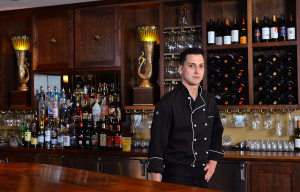 Hansen, 29, spent his formative years on a horse farm near Leesburg. He graduated from college in New Hampshire, and after a stint of washing dishes and making salads at a local restaurant while attending school, switched majors and devoted himself to becoming a chef.
Upon graduation, he landed a job at the highly rated Marea Ristorante in Manhattan in 2007. The restaurant scores a TripAdvisor 4.5 rating based on 886 reviews and set the stage for Hansen’s upward career arc.
Intrigued with working at the famous Le Cirque restaurant, also in Manhattan, Hansen applied for and was hired as a sous chef. International food experts rank the eatery among the best restaurants in the world.
“I learned more French cooking there and modern molecular gastronomy,” said Hansen. The technique employs chemistry and biology to suss out and enhance the aromas and flavors of food.
After six years away from home accumulating a growing expertise in the kitchen, Hansen was homesick for Virginia. “I hadn’t spent any holidays with my family because they all are busy times at restaurants,” recalls Hansen.
In keeping with his penchant for working at high-end establishments, the young chef landed a job at the Jefferson Hotel in Richmond. The beautiful five star, five diamond hotel is recognized as one of the finest in the country.
“At Jefferson I learned more from Executive Chef James Schroeder than anyone I had previously worked for, including budgeting and food ordering. I listened, asked questions and did everything to get myself into a position where I could confidently take on an executive chef’s position,” Hansen said.
The hard work paid off when he was approached to assume command of two establishments in Fredericksburg; Grapevine Café and Café New Orleans. With his growing reputation, Yarnall lured the young talent to Culpeper. Since his arrival last year, he has directed the firm’s catering and event center business while the restaurant was being built out.
“I want to make Flavor on Main a destination spot for Virginia. We are in a food revolution. People want and expect really good food with all natural products made in-house, not pre-packaged.
“Taste buds have changed and people have a way of picking up the phonies and knowing when people are legitimate,” emphasizes Hansen.
Today, Hansen and his wife and two-year-old daughter still live in the Fredericksburg area but plan on moving to Culpeper County. “I think Culpeper is the place where I want to live with my family; it’s the town I want to have my daughter grow up in.”
Reviews
Flavor on Main has been opened only a few weeks and critical acclaim still awaits. In the interim, the restaurant’s Facebook page is replete with comments from happy diners. A few of the observations include.
“Food so good we literally had to kiss the chef.”
“I love this place! Amazing food—hope you are ready for it. Atmosphere is so mellow and ritzy. Cocktails are out of this world phenomenal!!
“The food was fantastic. I had the flank steak and it was cooked to a perfect medium rare. The price points were also very reasonable.”
“Our waiter was extremely attentive to our table so between the great food and outstanding service, I have to give it an easy 5 star rating.”
Indeed, its Facebook page has already scored 648 likes with a 5.0 star review from 24 diners.
Hansen’s motto has been the same no matter where he has worked: “Stay fresh and stay local.” With that philosophy in play, the restaurant should have diners coming back often.
Flavor on Main is located at 137 S Main St and opened Tuesday through Friday 5 p.m. to 10 p.m.; Fridays and Saturdays 5 p.m. to 11 p.m. Its website will be up and running in the near future. For reservations call (540) 321-4510.

Published in the April 2, 2015 edition of the Culpeper Times
Local emergency care couple face own medical crisis
On February 11, Tommy and Heather Brown joyfully welcomed their son Alexander Wesley into the world. But within two hours, the baby boy was being transported to the University of Virginia Medical Center with life threatening lung and heart aliments.

Alexander Wesley Brown
The Browns experience health crises daily but it always involves others. Tommy Brown is an emergency room technician at the Culpeper Regional Hospital and Heather is a 911 dispatcher in Orange. They both volunteer with the Culpeper Rescue Squad.
Juggling the demands of competing medical emergencies is second nature to the hard working couple. But little prepared them for the emotional and financial crisis that occurred when their son was born with major health issues.
Alexander’s birth appeared normal at first. Heather came to almost full-term at 38 weeks gestation but delivered caesarian section; she had incurred some liver and bladder issues during her pregnancy but has recovered her health. Her son weighed a respectable six pounds 14 ounces at birth.
But shortly after transfer to the hospital nursery, respiration tests showed the baby’s oxygen saturation levels were in the 70 percent range; normal is mid-90s. Dr. Williams, the attending pediatric physician, quickly determined the condition could not be treated in Culpeper.

Alexander & Heather
Fortunately for Alexander, the world famous University of Virginia Medical Center was an hour’s ambulance ride away. A Neonatal Transport Team was called into action. The team operates with three professionals and is on-call around the clock.
Tommy Brown accompanied his son on the swift drive to Charlottesville. His mother followed the next day.
Diagnosis

Alexander Wesley Brown
Once in the highly specialized world of UVA pediatrics, it was determine that the baby had been born with a hole in his lungs and they were prematurely developed. The diagnosis was pulmonary hypertension. The resultant cardiac pressure had also enlarged his heart.
He was placed on an extracorporeal membrane oxygenation machine, or ECMO; commonly referred to as a heart-lung machine. The equipment provides cardiac and respiratory support for patients whose heart and lungs cannot function on their own.
Under the care of the professional staff at UVA, Alexander has improved significantly but is not yet ready for discharge.
While his enlarged heart has returned to normal size his lungs are still a problem. He has been taken off the ECMO machine but is still on a ventilator. The doctors are in the process of weaning him off that machine.
“It’s a slow process until he can use his lungs on his own. They need to open up so he doesn’t need machine support to breathe,” said Heather Brown.
As is often the case with difficult medical conditions, an additional problem developed. Alexander is now having difficulty digesting food and may have developed protein intolerance. The parents are hopeful that condition will resolve soon and they can all return home.
“If he stays the path and gets on his own, it’s a minimum of another week at UVA,” said Heather Brown. “He needs to be able to breathe on his own. And then they need to be sure he doesn’t have any additional issues.
“They started feeding him Sunday and they checked his stomach and he hadn’t digested anything.” Once the stomach issues are resolved baby Alexander will be released.
“We have to give a big thanks to the Culpeper Hospital Family Birth Center and to Dr. Williams. He identified Alexander’s problem quickly. If he didn’t transfer him when he did, my son probably would not have made it,” Tommy Brown said.
Coping
The Brown’s have been living in Charlottesville since February 12. They are staying at a hotel five minutes from the hospital. They are on leave from their jobs and spend 10 hours a day with their son. They are grateful for the support their employers, family and friends have provided them during their ordeal.
“Our employers have been very understanding,” Heather Brown said. “They have supported us. My co-workers made dinners for my family and Tommy’s co-workers sent a care package down to the hotel. Our employers have been great.”
Both parents of the couple have been helping with their other two children, ages four and eight. “They’ve been getting the kids down here regularly to see us,” Heather Brown said.
As their son’s medical condition continues to improve, the looming financial costs of the ordeal will begin to face them.
While they do know their insurance plans will cover some of the medical costs, they have not had any contact with the companies regarding specific coverage. “The ambulance ride alone cost $10,000,” said Tommy Brown. “And the EMCO machine was $3,000 a day. We’ve already spent over $2,000 on hotels and meals.”
Fundraiser
One of the couple’s good friends, Christy Hoeffer, has created a fundraising website for people to make contributions to help cover current and future medical costs. The site is http://www.gofundme.com/. The search code is: Healing Baby Alexander.
The site has already generated $3,920 from 49 donors. On the site Hoeffer states, “You may know Heather and Tommy Brown. They are the most selfless people I have ever had the pleasure to know. Please keep Alexander in your prayers and if there is anything you can contribute or do for them it is appreciated.”
Anyone interested in helping the Browns are encouraged to support the fundraising effort. It is a fitting way to repay these two Culpeper citizens who have given much to the local community.

Alexander & Tommy
Published in the February 26, 2014 edition of the Culpeper Times.
Carson Ashley embodies full service land use consulting
Visit the Carson Ashley web site and a dizzying array of services is displayed under its “Services” banner; 37 to be precise.
If it has anything to do with civil engineering, land planning or land surveying the firm has it covered. And in the off chance a client need is not listed, don’t panic. The company would likely amend the list to 38 offerings.

Jim Carson
“We provide a high degree of customer service. Our firm is not a ‘hired gun’ environment. Our clients trust us and we trust our clients. We work together and we fight for them,” said Jim Carson, managing partner of the firm.
The corporate philosophy is central to the reason the Warrenton firm has thrived for 40 years. Carson is the third owner of the company. He purchased it on Christmas Eve 1997 and joined forces with Rick Ashley to continue providing land use services to the Piedmont and Northern Virginia areas.
So how did an up and coming entrepreneur continue the legacy of an established firm? Rely on the forces that helped achieve its original success.
After he purchased the firm “I did not have a dime to my name. Everything was in the business. I thank Mr. Harris, the previous owner, and his employees who continued to work at the firm,” said Carson. Harris retired in 2002.
Today, the company has 16 employees dedicated to “helping property owners avail themselves of the maximum potential of their property within government regulations.”
The firm handles approximately 100 projects annually with 85 of them being relatively short-lived smaller jobs. The profile tracks closely to the “80-20 Rule” that 20 percent of a firm’s business contributes 80 percent of its revenue.
The company is focused on front-end development of land use but can span the entire gamut of “soup to nuts” property fulfillment. Clients range from individual families to holders of large subdivisions. Size doesn’t matter. Achieving landowner goals does.
Unraveling the land development process highlights how involved each stage can be—or not. A small project might simply require quickly dividing a family plot into two parcels. Larger commercial jobs spanning hundreds of building lots can evolve into a decade-long effort.
“We completed a rezoning last month for about 200 building lots. It involved taking a piece of ground without plans and figuring how to fit 200 lots on it and then carrying the project all the way through the public process to get it approved,” said Carson.
Large projects start off with an initial surveying of the land, then creating a plan as to how the subdivision will look. From there it proceeds to engineering the plan, preparing construction drawings and obtaining county approvals.
Those steps lead to securing work permits, platting the sites, obtaining bonds, construction stakeout and bond release work.
The required interface with county governments underscores the level of professionalism that is brought to bear in successfully bringing a major subdivision to fruition.
Perhaps the old colonial British saying of “slowly, slowly catchee monkey” might best describe the process. Patience is victor in this industry.
The economy
 Few business stories can be told today without addressing the moribund economy of the last several years. If lost business produces heartaches, then its surprising local intensive care units haven’t seen long waiting lines.
It’s been a painful time for men and women who own their own businesses. Carson Ashley is no exception.
“The economy really crushed the real estate business. And we are very much vested in real estate,” said Carson. “The bulk of our work was impacted by the real estate and housing slow down.
“The housing slow down affected our residential business and the commercial segment was affected by the tightening of lending; in large part because of the uncertainty in the market. Even if somebody had a great idea, they wouldn’t pull the trigger because of the uncertainty of things,” opines Carson.
Reading the 2007 recession tea leaves, Carson assumed it would take two or three years for the economy to bottom out, recovering by 2011. That prognostication slipped by two years. “And I didn’t have plan for those two years,” said Carson.
He goes on to say his firm is still not fully out of the doldrums. “It has stabilized. As I look into the future I see people doing stuff. But I personally don’t see us going back to anything like 2006,” said Carson.
He goes on to explain the Northern Virginia economy is not going to be the huge engine driving the economy as in the past. “Federal Government spending and employment reductions are going to slow down things.”
Underscoring his typical optimistic life view, Carson thinks growth will occur but will not be robust.
He also notes an economic pattern based on long experience. “As things get hot, people get interested in doing projects and I get work in Northern Virginia, Winchester, Culpeper, Luray, Stephens City and all those places. When it contracts, I’m back to working jobs in Prince William and Fauquier.”
Today, he sees an expansion outward again and thinks more of his work will come from a widening geographic area.
Business acumen
“Carson learns the hard way. I don’t learn from books. OK, I do learn from books but I don’t take it home from books,” said Carson laughing.
Freely translated that means learn and absorb from multiple sources then execute based on both mind and heart. “As a business owner the hardest thing to do is be a business owner,” observes Carson.
He emphasizes that owners often get into a business they love, enjoy or one that inspires them. But the art of actually running a business is focused more on a global perspective and letting qualified employees perform the actual work.
The sooner one realizes employees can run the day-to-day operations “the better off you are. Running the business is your number one responsibility.”
It’s not easy to balance the two sides. Carson delegates but admits it’s hard to do. Letting others perform can result in possible mistakes or more often tasks getting done but perhaps not quite the way the boss would do it.
“But the result is the same. If you micromanage, you are not looking at the long term goals of the company. That’s why most businesses fail,” said Carson.
The most influential business book Carson read is The E Myth by Michael Gerber (an updated edition is titled The E Myth Revisted). The title refers to entrepreneurs who often are great idea people but poor business owners. Its theme is leaders need to free themselves from daily work tasks and focus on the long-term success of the companies they are piloting.
Easier said than done. “It’s hard, especially when it’s your business. You are passionate about it. You live it every minute of the day but you can’t work 90 hours a week,” said Carson.
From here to where
Looking back on 18 years as a business owner Carson characterizes his mind set today as “We are not done. We’ve achieved some great success then the recession sort of stripped it away. We are now rebuilding. It’s coming together.”
He humorously states his middle name is Perseverance and a biblical quote reflects his take on the recent past. “…but we glory in tribulations also; knowing tribulation worketh patience.” (Romans 5:3).
Moreover, he stresses customer service is paramount in today’s business environment, a concept seemingly lost on many firms. As the economy picks up steam he states, “We are getting more chances to exemplify customer service.”
“We have been successful because we got things done faster, better and smarter than many firms.
“We have very professional, qualified, capable, and experienced people. The work is coming back and we are able to put that talent to work for our clients. And that’s a good thing,” said Carson.
Published in the Winter 2015 edition of The Business Journal.

Horizon Real Estate, Inc. led by experience with a smile
When seeking a real estate firm to help sell or buy a home, a client seeks out a knowledgeable agent who is attentive to their needs. After all, it’s likely the biggest financial transaction of their life. Optimistic business acumen makes good things happen quickly.

Loni Colvin
And making good things happen is the hallmark of Warrenton real estate broker Loni Colvin. Goal setting is not a dry business term to Colvin but rather the mantra she lives by. “I never feel like I hate getting up in the morning and coming into the office,” said Colvin. “I love helping people.”
As a result, over the years a cavalcade of individuals and couples have felt that love and gotten into a home on its cresting wave. The energy driving this successful real estate entrepreneur is not about to let up either. “I don’t ever want to retire,” said a laughing Colvin.
The native of Kentucky catapulted out of the Bluegrass state in 1989 and hasn’t slowed since. It’s been a trajectory of success with several businesses now a memory as she accumulated experience and moved on to bigger challenges.
In the beginning
After arriving in the D.C. area, Colvin worked for a Roy Rogers restaurant as general manager while doing cleaning on the side. Her fiancé, now husband, suggested she start a cleaning service and she took the advice. “It’s because of him that all of this other stuff has happened,” Colvin said.
As the cleaning service evolved it led to snowplowing. She had contracts with the town of Warrenton for a couple of years and her cleaning business blossomed with 14 daytime employees and a smaller staff working nights cleaning office buildings in Prince William County and elsewhere.
The business success led to the idea of starting a property management company. She obtained her real estate license 2000 and began focusing on real estate. She eventually closed the cleaning business to devote full time to selling real estate.
What happened next was as assured as the sun rising. She met with immediate success and in 2001 was named Rookie of the Year by the Greater Piedmont Area Association of Realtors.
She was subsequently recognized for her performance with multiple awards with names such as Platinum and Chairman’s Club. Over the course of the next several years, Colvin worked at three different real estate firms, gaining more experience with each passing year.
In 2006, she sold $26 million worth of properties, earning the distinction of being placed in one company’s Hall of Fame.
“I remember the broker telling me I had achieved a big thing. I was in the top 2 ½ percent of the nation’s real estate agents,” said Colvin.
In 2009, her peers installed her as the President of the Greater Piedmont Area Association of Realtors. But there was no resting on her laurels. Hard work, some disappointment and greater success lay ahead.
Industry structure
Titles used in real estate can be a bit confusing. Who does what and why? Let’s recap the meaning of the most frequently used industry titles:
Real estate agent: Simply anyone who earns a license to sell real estate. State requirements differ but in every state the person must take a minimum number of classes and pass an exam to earn a license.
REALTOR®: An agent that is a member of the National Association of Realtors®. The person must uphold the standards of the association and its code of ethics.
Real estate broker: An individual who has pursed education beyond the agent level and passed a state’s broker license exam. Brokers can work alone or can hire agents to work for them.
Real estate associate broker: A person who has taken additional classes and earned a broker’s license but chooses to work for a broker.
In Colvin’s case, after gaining extensive experience as a real estate agent she elected to purse a broker’s license. The move set the stage for her next career step.
On her own
In 2008, after eight years in the industry, Colvin obtained her broker’s license and struck out her own and founded Horizon Real Estate, Inc. To paraphrase Charles Dickens, it was the best of times and the worst of times. Yes, she now headed up her own agency but she launched it at the onset of a severe recession.
Timing is everything. “It was the worst of times. My building fees were overwhelming but I made through that period,” said Colvin. She started with one employee and three agents in a snail’s paced economy. Today, the office, located at 26 N. 5th St., is home to three administrative employees and 25 agents.
“I looked at the companies that had closed and merged and had no clue of being a broker myself. But I have a great group of agents at my office. We all worked together. It’s wonderful,” said the always expecting the best Colvin.
She is also poised to open a second office in Front Royal in October. The office will initially be staffed by two agents but if the past is prologue, look for her to attract additional agents into her sphere of success.
In 2009, she became certified as a real estate instructor and launched yet another business teaching potential agents. Given her track record, being a student in one of her classes is key to launching a new career. It is a 60 hour course conducted to fit a student’s schedule. To date, 20 students have graduated from the school and she has brought an additional instructor on board.
Most recently the energizer broker opened a title company appropriately called Sunshine Title & Settlement. It recorded the first of many deeds to come in early September and adds another entity to her growing number of businesses.
Ever looking beyond today, Colvin has plans to open another agency when her work schedule permits. It is already licensed and ready to go and will operate under the name Ches-Bay Real Estate in Hartfield. “Today Warrenton, tomorrow Virginia” might be her mission statement.
Model for success
The mark of a successful executive is to envision their company five years into the future. If they focus on the here and now, stagnation can set in. To underscore the philosophy Colvin said, “I don’t look at how much I’m earning. I’m looking to grow the business. As long as I’m still going forward that’s an accomplishment.”
Colvin’s advice for a successful career is for people “to figure out what they want to do and what they enjoy” because then it’s not a job. Goal setting is paramount for her. And while she won’t elaborate, it’s obvious her goal oriented work ethic is alive and well with bigger things to come. “I will never retire because I’m having too much fun.”
Her advice to those looking to advance is to “follow your heart” and don’t listen to other people. “When I started out I didn’t have deep pockets. You have to believe in yourself and believe in what you are doing,” she said.
Another critical element to her success is “I’m honest. I’m fair. I treat everybody the way I want to be treated. You can’t get what you’re not willing to give.” When managing her employees if there is a problem in a business relationship she meets with the individual and asks, “Tell me what you think I need to be doing to help you succeed.”
One of her pet peeves is a lack of commitment. She emphasizes she doesn’t ask 100 percent from an employee but “if you’re not giving 60, 70 percent then you’re not moving forward.”
When a new agent joins the company, Colvin knows it’s her responsibility to help them succeed. “They’ve come here because they believe in Horizon. I am going to help them. I can’t let them down,” said Colvin.
When asked how she would summarize what she has achieved Colvin said, “I love laughing. I pray a lot. I’m always positive. I wake up every day and thank God for what I’ve got and for everything that’s coming in that day. And if it’s a bad day, I say ‘OK’ its’ been bad but let’s get on with the new.”
If one were to check a thesaurus for the word success, one of the synonyms might likely be Loni Colvin.
Published in the Fall 2014 edition of the Piedmont Business Journal.
Summit Community Bank leader seeks to personalize financial services
Community banks play a valued role in a local economy. The institutions are typically operated by local or regional owners and focus on the needs of businesses and individuals living where it’s located. Think Wall Street comes to Main Street.
The banks help keep local economies growing by providing a host of financial services. When lending decisions are made by people who know their community needs, the entire citizenry benefits.
“I love being here. I love being able to know most of my clients on a first name basis,” said Trisha Hwang, branch manager and assistant vice president of Summit Community in Warrenton.
Hwang connects deeply with her customers and is rewarded by getting to know their children and helping their families achieve financial goals “much more so than I could if working in a larger bank.”
Hwang has a resume of management experience that dates to her first job at 16 when working in the fast food industry. Her position today is enhanced by growing up in a small town in western Kentucky and subsequently working retail in Ohio where she met her husband.
In 2003, the couple moved to Loudoun County and Hwang landed a job in a large bank. Banking provided more predictable and stable work hours than retail management and it enriched her experience by working for a large financial institution.
What happened next is typical for a person on the move. In 2008, a headhunter called. Was she interested in a position at the Summit Community bank in Warrenton? Say what? She accepted the job.
“It’s been a wonderful experience having been able to work in both worlds—a larger bank and smaller community bank,” said Hwang.
She reminisces on the old chestnut that the grass is greener on the side. “Some things run more effectively in a larger bank and some more effectively in a smaller one. At the end of the day, it’s a question of are you happy where you work,” said Hwang.
And this banker is happy. Very.
Hwang manages a staff of three; a customer service representative and two customer service tellers. The bank also employs a commercial lender with an assistant and a chief banking officer also with an assistant at the same location at 250 Lee Highway.
Summit Community history
Summit Community Bank is headquartered in Moorefield, W. Va. and dates its founding to 1883 as the South Branch Valley National Bank.
South Branch Bancorp was formed in 1987 and in 1999 changed its name to Summit Financial Group. Today, the bank has 15 community banking locations; nine in W. Va. and six in Va.
 When the Warrenton office opened in 2005, the bank’s initial objective was “getting our name out, having a face with that name and making sure people knew us. We don’t do a lot of advertising like larger banks do. But today we are a force to be reckoned with,” said Hwang.
“We have really great products. We show people what we can do for them. One of our mottos is ‘We put ourselves in your shoes’. If you are sitting on the other side of the desk from me, I want to know what I can do for you.”
While Summit Community is a local institution, its services are national in scope. It is a full service bank offering checking and savings accounts, money markets, home equity lines of credit, insurance, investments, and retirement planning. “You name and we do it.”
“There is an assumption that because we are a smaller community bank we don’t offer investment advice, retirement planning or mortgages, but we do,” said Hwang.
She underscores the bank has grown during a difficult economy and has fewer loans going into default. “We try to work with those customers because we understand everybody has gone through a difficult time as some point in their lives. We believe in offering a helping hand.”
She also sees signs the local economy is starting to right itself. Compared to 2008, more personal savings accounts are being opened because she thinks people are beginning to set aside some of their earnings for the proverbial rainy day.
But is the economy finally back? “It depends on who you are talking to and it depends on the month. Some months I attend ribbon cuttings and it’s great to see the new businesses open. But at the same time I see firms going out of business too,” said Hwang.
Building the bank
All successful companies seek to create and build solid customer relations and banking is no exception; perhaps more so than for many firms. “I regularly visit businesses in our area,” said Hwang. “I take clients to breakfast or lunch and talk about our product offerings; checking and savings with no minimum balances or monthly fees and more.”
She seeks to educate on not only Summit Community offerings but banking issues in general. “When I return from an appointment my staff is eager to know, ‘How did it go? Did you get the account?’ but I tell them that’s not what it’s about. It’s more about building the relationship,” said Hwang.
To reinforce her point, Hwang recalls a business customer who made an appointment to discuss opening an account. “He told me he remembered me giving a presentation to a local group a few years earlier. He became a customer because of that initial contact. I plant seeds in this business. You might not need us today but you could later on. Being friendly and accessible to everyone pays offs,” said Hwang.
During a typical off-site meeting, the banker spends about 15 minutes discussing her product line and “package account” of services, including no charge for ATM usage at other financial institutions. Summit even refunds such fees incurred at other banks. The perks of many of the bank services is attractive.
Her secret to signing new accounts is to listen to the potential client before discussing her product line and asking questions to better understand actual needs. “Often they simply want to be heard,” underscores Hwang.
Hwang takes the time to educate on the merits of her offerings and not try to force a sale. Selling the customer may come later when their comfort level with the bank is secure. One particular attractive product is a savings plan earning one percent interest. “The national average is .2 percent so our rate is a big deal,” said Hwang.
Knowledge coupled with friendly patience pays off. In today’s world, no one wants to listen to a pressurized sales pitch. The days of the iconic Willie Loman in Death of a Salesman are gone.
Additionally, while the bank has a plethora of products it’s important not to treat each in an in-depth fashion. If she has 10 things to share with a promising client, she will not attempt to discuss all of them. Understanding where an interest lies will lead to deeper and more fruitful discussion of the bank’s services that are actually needed.
After six years with Summit Community, Hwang’s sales philosophy is not to product- push but rather provides for immediate needs and waits for satisfied customers to return for additional services.
“I deal in a down-to-earth way with clients. What’s best for them today may not work six months from now,” said Hwang. If a solid relationship is established in the beginning, customers will likely return to explore ways to address new financial challenges.
If all this sounds like common sense being brought to bear in a complex industry, then it’s easier to understand why this bank is climbing steadily toward the summit of success.
Published in the Fall 2014 edition of the Piedmont Business Journal.
Warrenton Huntington Center scores high marks for students and owner
Donna Isler’s love of learning is in her DNA. Her great, great grandfather was the first black lawyer in Washington, D.C. Her grandfather was head of the Linguistics Department at the University of Michigan and her father led the Orthodontics Department at Howard University.
“Education is in my blood,” said Isler. Education, coupled with a driving work ethic that created five tutoring centers in 10 years. “I’ve always believed in providing every student the best education possible.”
The Jamaican native knows first-hand those who are not able to receive an education because of the cost. Being able to help others is “extremely important” to her.
Early in her career the speech language pathologist worked at D.C. General Hospital and for the Fairfax County school system. But the entrepreneurs lurking in her and her husband wanted to build a business of their own. “It was the combination of my passion for education and his desire to own a business that we ended up choosing Huntington,” said Isler.
With over 37 years experience in premier student tutoring, Huntington Learning Centers is a pioneer in the field. It has a proven model in supplemental education for those committed to building a successful franchise business.
“What we really liked about Huntington is the founders are actively involved in the business,” said Isler. “We see them every year at various meetings.”
Each franchise is independently owned and operated and is provided corporate support in teacher training and student instruction methodology.
In 2005, Isler opened her first center in Manassas and subsequently opening centers in Fredericksburg, Lake Ridge, Stafford, and Warrenton. She has 15 full-time administrative staff and employs 25 to 32 part-time certified school teachers at each location.
Success is demanding
The firm’s growth has been steady but demanding. “Five centers is a lot to manage,” said Isler. In the tutoring industry customer service is extremely important. “It’s not as easy as I would have anticipated.” Hiring and training staff, while still teaching whenever she can, requires a full-time commitment.
Her favorite aspects of the job are administering student evaluations and working with parents. The evaluations are critical to a student’s performance since it identifies strengths and weakness prior to developing a specialized program of instruction.
“It’s an academic x-ray,” Isler explains. “It pinpoints the areas to work on and focuses on an enrichment program of remedial study skills.” The emphasis is often on building reading, comprehension and math skills.
All of the instruction is individualized with recommendations to parents on what can be done at home to reinforce classroom instruction. One typical technique Isler uses is assigning students the task of reading a newspaper then writing a summary of what they read. “Writing is the active form of reading,” she emphasizes.
Each center has 38 to 70 students depending on the time of year. There is no set time limit for the length of individualized instruction. Typically, during the school year a student will attend four to six hours a week. During the summer program it runs 12 to 16 hours.
“When school is out Huntington is in,” said Isler. “It’s the perfect time for students to build their skills for the upcoming school year.” Mid-June to mid-April is the busy time of the year. Issuance of second semester report cards—when detention notices go out—also see an increase in student enrollment. Alarmed parents want help immediately.
While 90 percent of the student body is kindergarten through 12th grade, adult instruction is provided, often in building English language skills and the study of foreign languages, mostly French and Spanish. “Our oldest student was 67,” said Isler.
Business strategies
Operating a small business is fraught with challenges. The moribund economy of the last several years has taken a toll on many local businesses. One negative impact unique to the DC area was the government shutdown in 2013.
With government and military families laid off during the shutdown, parents were worried about spending money for tutoring. It’s difficult to make such an investment when concerned about paying household bills.
School closures due to snow days in 2014 also saw a reduction in the number of Huntington students.
“We’ve had to get creative on how to cut expenses and while working with parents so they can continue” sending their children to the centers.
Active involvement with the business community is key in building the firm. Isler uses grassroots marketing to increase student enrollment. This includes providing promotional literature to appropriate restaurant, retail and medical offices that highlight the importance of tutoring.
Often customers have free time while waiting for appointments or services and can educate themselves on the benefits of a Huntington student experience. The firm’s newsletter “Huntington News for Parents” is a vehicle for driving business to the company while providing useful information to parents of school-age children.
Additionally, newspaper advertising, Google Adwords, direct mail and parent referrals help strengthen the business. It’s a multi-channel approach employed on a daily basis. “Yes, it’s a franchise firm but it operates as a small business” and it is up to Isler and her staff to build enrollment.
In the course of ten years, Isler has learned two important lessons: listening to her staff and learning from past mistakes. When things don’t go right one needs to develop a more effective response to a problem to avoid repeating it.
As an example, working within the Huntington structure requires compliance to proven educational strategies the corporate firm has developed. “It’s like learning a new language and new ways of doing things. I can’t expect a new teacher to pickup up the Huntington system and perform at the same level as I do. Everybody has a different learning curve,” said Isler.
So she has to work closely with instructors to assure the classroom strategies are implemented. One mistake she learned from was retaining staff that was unable to accept the Huntington instructional format.
“It’s was hard letting go of teachers who could not adapt to our structure but it’s necessary to the success of student performance,” said Isler. In some cases teachers simply cannot implement the necessary curriculum given their previous training. “We must follow our program because it works,” said Isler.
Personal satisfaction
After ten years in building the business this passion-driven educator even now becomes emotional when enrolling a student. “I still cry during the initial conference” if parents are struggling with a child in need. “But it’s very gratifying. There’s nothing better than when a light bulb goes off and a student makes a learning connection. It’s the moment they get it and they understand it.”
Other collateral rewards unfold when a student comes to class excited about their first B on a school exam. Or a parent relates how their son wants to pickup a book and read it when he has never wanted to in the past.
So what might be some important lessons learned in achieving success? “First, don’t take on more than you can handle. I am married with three children. I still work on the weekends. It’s gratifying but hard work.”
Secondly, success is all about customer service. Meeting and greeting new parents and students is important. “It’s like inviting them into your kitchen and having a conversation. The family is bringing their child to us because of academic concerns. By the time they leave that are literally changing their child’s life,” said Isler.
The success of the center even extends to her daughters. All three of her children attend the Huntington center to further improve school performance.
“I truly believe in this business,” said Isler.
Published in the Fall 2014 edition of the Piedmont Business Journal.
High expectations need to be held in check when starting a small business. Only 44 percent survive after four years and the average life span is eight and a half years.
Yet this year, Battlefield Travel of Culpeper is celebrating 30 years of success and still going strong. The E. Davis St. firm’s secret? Consistently planning and providing successful travel experiences.

Cheryl Clear
“If we weren’t good at what we did, we wouldn’t be around for 30 years,” said owner Cheryl Clear. And there are no plans to close shop. “Battlefield will be around for considerably more years.”
That’s not hubris talking. Clear has a staff of four that have an accumulated six decades of experience in making vacation dreams come true. The key to the successful business is agents who are widely traveled.
“Our certified travel consultants have over 60 years combined experience,” said Clear. Traveling the world provides her clients vacation getaways to places the consultants often have firsthand knowledge of.
Experience combined with educational training further assures successful adventures. Clear is an Elite Cruise Counselor, Certified Travel Agent and holds certifications in various fields of travel. Her sheepskins are brought to bear with each client encounter.
Survival
While enjoying multiple decades of achievement, it doesn’t mean there haven’t been bumps in the road; sometimes big ones. “I purchased the agency in January 2001. Then 9/11 happened. It hit us really hard. I had to downsize,” said Clear.
The business had to relocate to smaller quarters and the only staff she retained was her receptionist. But perseverance prevailed and today her staff is back to the same size as when she assumed ownership.
Interestingly, and fortuitously, when the recession hit business actually increased. While the cruise segment of travel declined, Clear realized working professionals were more insulated from the impact of the recession and continued to travel worldwide. She focused on selling excursions to this market segment.
“Because we had been around so many years people knew who we were. We have a good reputation so we made more money than before the recession,” said Clear.
Reputation is golden. As a result, the business has ceased most forms of advertising. “Most of our marketing today is word of mouth. I found advertising did not make that much difference. Past performance is our best marketing tool,” said Clear.
The industry
There are two key benefits in employing a travel agency. First, except for airline ticketing fees, there typically are no extra charges levied by the agency above lodging and airfare costs. There is an hourly charge if a specific itinerary is requested.
Agents are usually compensated by the companies they use to book lodging. “It’s not going to save anybody to not go through a travel agent. Lodging and air fare will be the same,” said Clear.
Secondly, often an agent’s personal experience will be employed to plan a vacation. Imagine a relative going to Ireland and later sharing every step of the trip. It’s same with an agent. No muss. No fuss. Board the plane and fly off to happy times.
“One of my agents spent two weeks in Italy. There is not a whole lot about Italy that she can’t tell you,” said Clear.
She emphasizes her first question posed to a client is “What is your budget?” The answer will determine how the trip is assembled.
Clear also recognizes in the digital age vacations can be planned on a keyboard in the comfort of one’s home. But often it takes hours of research and the luck of the draw that a traveler has chosen well.
Conversely, an experienced agent frequently brings “boots on the ground” to the planning process. “We are not just selling trips. We are sharing our experiences. You can’t get that on the internet,” emphasizes Clear.
Today, one small trend Clear has observed is that Americans are turning more to domestic vacations. “I’ve noticed we are selling more Alaska and Hawaii trips and less of Europe,” said Clear.
Sounds like a good time to enjoy London, Paris or Dublin since there might be fewer tourists to compete with, eh?
Battlefield Travel is located at 163 E. Davis Street. Visit them in person or at battlefieldtravel@comcast.net. (540) 825.1393.
Published in the October 16, 2014 edition of the Culpeper Times.
Fauquier County manor house celebrates 200th anniversary
Virginia history is replete with scenic properties graced by memorable personages. One of the lesser known—but richly historical homes–is Fairfield, located in western Fauquier County.
There have only been 12 owners of the property since 1600; the property has not been flipped for quick profits over the ensuing centuries. Like the Commonwealth itself, stability is highly prized when it comes to Virginia legend and history.

Sunrise at Fairfield
The first owner of the property was Charles I of England, who held control over vast areas of land in the New World. In 1649, his son Charles II granted all the land between the Rappahannock and Potomac Rivers to Lord Culpeper and six other supporters. The grants included Fairfield.
Today, the current owner is Marriott International and the property has resized itself from hundreds of thousands of acres down to 4,200; a shadow of its former size but impressive nonetheless.
Story line
The land encompassing Fairfield is an artist’s palette of rolling pastureland. Seemingly it would have been the colonials who leveled the original dense forests to plant a variety of crops, most notably tobacco. But not so.
Centuries ago, Indian tribes of the Five Nations periodically burned off land in the area to create pasturage for deer, elk, buffalo and more. These natives were the Nation’s first land managers.
In 1608, Captain John Smith of Pocahontas fame traveled the interior of Virginia to where Fairfield is located. He was the first of numerous historical figures who walked, hunted or lived on the property in the ensuing four centuries.
George Washington fox hunted on the land, “The Gray Ghost”, Confederate John Mosby, periodically resupplied his rangers there, and at times the Quartermaster General of the Confederate Army of Northern Virginia was headquartered on the property.
Robert Ford—“that dirty little coward that shot down Mr. Howard”—or Jesse James as he is more accurately remembered, was born in a log cabin not far from the manor house. The cabin’s stone chimney stands today as a silent reminder of the bucolic-to-violent times of the mid-to-late 1800s.

Marriott & Reagan
Fast forwarding to the 20th Century, presidents, governors, and statesmen were frequent guests of J. Willard Marriott. Marriott and President Reagan became fast friends and spent many weekends at the ranch horseback riding and enjoying their mutual love of the out-of-doors.
The house
The manor house at Fairfield was built in 1814 by James Markham Marshall, brother of the fourth Chief Justice of the Supreme Court, John Marshall. John Marshall was the “Babe Ruth of the Supreme Court” having written or co-written over 1000 decisions.
The Marshall brothers, along with Raleigh Colston, paid $70,000 for 220,000 acres encompassing Fairfield after the Revolutionary War and divided the property into three separate ownerships with James taking possession of 80,000 acres.
The house was built in the Federal-style except for the roof. The hip roof reflects an Italian influence most likely due to the period that Marshall and his wife Hester spent in Europe. An east wing was added in the 1820s but the west wing was never built.
Bricks used in the home were a combination of ballast from ships coming from England and transported overland from Alexandria and those kilned on the property. Marriott Ranch General Manager, Lanier Cate said, “There is a huge carved out section of clay bank on the property that looks like it would have been the source to make the bricks.”
The rooms in the Manor House are twenty-five feet square, sixteen feet high with eighteen inch thick walls, making the house comfortably cool in an era predating air conditioning.
In September, the Marriott Ranch celebrated the 200th anniversary of the Fairfield manor house with a corporate celebration. Given the loving restoration devoted to the historic home, the celebration will commemorate its storied past and assured future.
___________________________________________________________________________
J. Willard Marriott
 In 1951, J. Willard Marriott and his wife Alice were seeking a getaway for the busy executive. At 53, he had already met with considerable success with more to come. The couple came upon Fairfield while driving the back roads of Fauquier County.
It was love at first gaze. Fairfield immediately reminded Marriott of his youth in rural Utah where as a young lad he herded sheep. At age 14, his father entrusted him to take 3,000 head of sheep via railcar to the San Francisco market. The young entrepreneur never looked back.
Until he saw Fairfield.
While the landscape of pastoral Fairfield was stunning, the historic manor house was not. It had been unoccupied for over 30 years and was in severe disrepair with a badly leaking roof and the first floor serving as a grain silo. The grande dame was slowly slipping away.
But Marriott was not wearing his executive cowboy hat when he purchased the 4,200 acres and manor house. He called the property Marriott Ranch and for almost thirty years offered its hospitality to his many friends and associates. It was a family farm.
Marriott and his sons never attempted to turn the estate into a resort but have lovingly restored the historic home and maintained the property as a sheep and later cattle ranch. It’s been an investment of over a million dollars.
In the late 90s, the manor house was opened as a seven room bed and breakfast permitting the general public to enjoy its history and beauty.
Lanier Cate, general manager of the ranch says, “Fairfield is a working cattle farm and a historic home that J. Willard saved from decay and destruction.” Another owner could well have subdivided the land and razed the old home. But stewardship prevailed.
Today, Fairfield is a legacy of the Marriott family, a gift to Fauquier County and a treasure for the Nation.

Fairfield Manor House
Published in the Fall 2014 edition of inFauquier magazine.
